Airlines Owe You Cash for Canceled Flights… So They’re Redefining “Canceled”
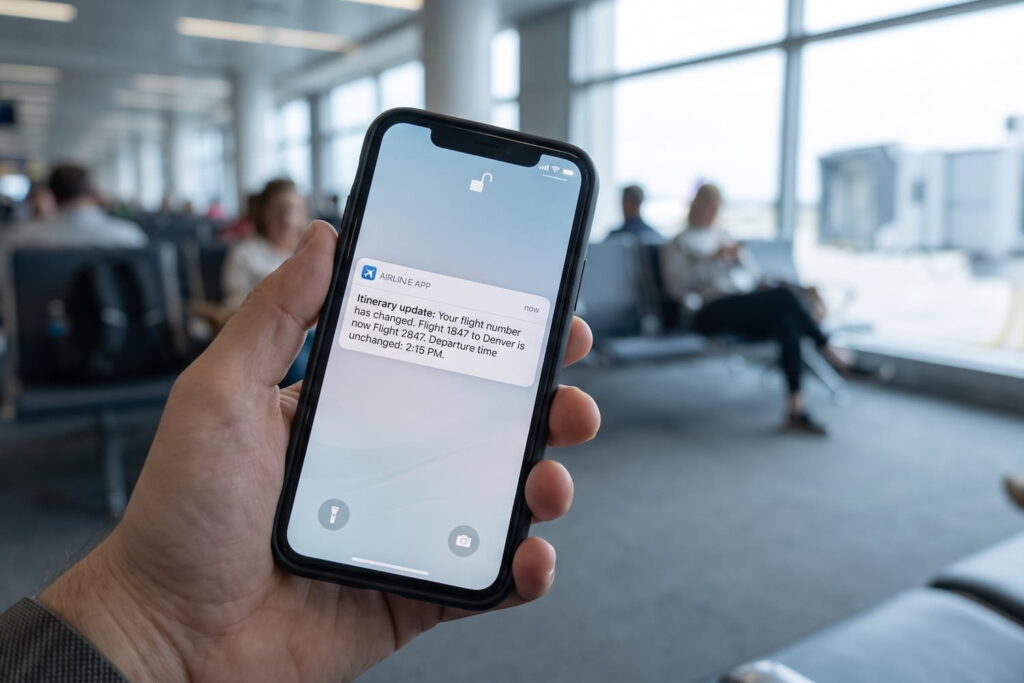
Somewhere in an airline’s scheduling system, a flight you booked months ago quietly ceases to exist. The plane still leaves. The departure time barely moves. Your seat is still yours. But the flight number you purchased – the one printed on your confirmation email – is gone, replaced by a new one.
Under federal law as written, that flight was just canceled. And a canceled flight means the airline owes you a cash refund, automatically, within seven business days.
Since December 5, 2025, the Department of Transportation has been officially looking the other way. On July 7, it agreed to keep looking the other way until at least July 2027.
The Rule That Took a Pandemic to Write
Airlines have been legally required to refund passengers for canceled flights for decades. The Department of Transportation reminded them of it after 9/11, after Hurricane Katrina, and – most loudly – in April 2020, when it issued a formal enforcement notice telling carriers that a global pandemic did not suspend their obligation to give people their money back.
The airlines heard something different. As COVID grounded fleets in the spring of 2020, carriers canceled flights by the tens of thousands and handed out vouchers instead of refunds. Passengers noticed. In 2019, the DOT received 15,332 complaints about airlines all year. In 2020, it received 102,550 – and 89,518 of them, 87 percent, were about refunds.
There was a structural reason airlines felt comfortable stalling. The refund obligation was real, but its two operative terms – “cancellation” and “significant change” – were defined nowhere. Not in statute. Not in regulation. The DOT admitted as much in a May 2020 FAQ, acknowledging that carriers were “free to develop reasonable interpretations” of what those words meant. Every airline got to decide, for itself, what counted as canceling your flight.
The enforcement bill eventually came due. In November 2022, the DOT ordered six airlines to pay back more than $600 million in withheld refunds – Frontier alone owed $222 million – alongside $7.25 million in civil penalties. In December 2023, Southwest was hit with a $140 million penalty for its holiday meltdown, thirty times larger than any consumer-protection fine the agency had ever issued. In June 2024, Lufthansa, KLM, and South African Airways were penalized over delays in paying back more than $900 million more. By that point, the DOT counted nearly $4 billion in refunds and reimbursements returned to passengers since the pandemic began.
And in April 2024, the agency did the thing that made the whole fight legible: it wrote the definitions down.
The Definition Was the Whole Point
The DOT’s final rule, “Refunds and Other Consumer Protections,” published April 26, 2024, required airlines to issue refunds automatically – no request, no phone tree, no voucher offered first – in cash or to the original form of payment, within seven business days for credit card purchases. Congress then made it statute. The FAA Reauthorization Act of 2024, signed May 16, 2024, after passing the Senate 88–4 and the House 387–26, wrote the refund mandate into 49 U.S.C. § 42305.
For the first time, federal regulation defined the trigger terms:
- A canceled flight is “a flight that was published in a carrier’s Computer Reservation System (CRS) at the time of the ticket sale but not operated by the carrier.”
- A significant change is a departure or arrival moved by three hours or more domestically (six internationally), a different origin or destination airport, added connections, a downgrade in class of service, or – for passengers with disabilities – a change that removes needed accessibility features.
Either one entitles you to walk away with your money, even on a “nonrefundable” ticket, if you decline the alternative the airline offers.
Notice what the cancellation definition hinges on: the flight, as published, under its flight number. That specificity was the fix. It took away the interpretive wiggle room that airlines had exploited for a decade. A flight either operated as sold, or it didn’t.
It also created a very precise pressure point. If the definition is the flight number, then changing the flight number – even on an otherwise identical flight – is technically a cancellation. And if the definition could be loosened to something vaguer, something more like “the itinerary, more or less”… the wiggle room comes back.
Eighteen months after the rule took effect, that is exactly the negotiation that began.
The Airlines Asked. The DOT Said Yes.
The requests came in through the front door, politely, on letterhead.
In March 2025, Alaska Airlines and Hawaiian Airlines – mid-merger, and renumbering “tens of thousands of flights” as they integrated their networks – asked the DOT not to treat those renumberings as cancellations. The agency granted that request in a case-specific letter dated March 24, 2025.
In comments filed to the DOT’s deregulatory review that spring, Airlines for America – the industry’s chief lobbying group – and the International Air Transport Association argued that a flight-number change should never count as a cancellation at all. A4A went further, calling the automatic refund rule itself a “gross example of unlawful Federal overreach” and urging its repeal, as The Points Guy reported. Then, in a letter dated November 17, 2025, American Airlines asked for the same relief Alaska had received – citing its routine practice of shifting flights between mainline and regional operators.
On December 5, 2025, the DOT published a notification of enforcement discretion in the Federal Register. The notice is candid about what the rule requires: “a flight that is given a different flight number than was assigned when the consumer purchased the ticket is considered a new flight and the original flight is considered a cancelled flight for which the consumer is eligible for a refund.”
Then it announces the agency will not enforce that requirement – specifically, 14 CFR 260.6, 260.9, and 399.80(l) – whenever a flight is renumbered, the passenger is rebooked on the renumbered flight, and the flight operates without a significant change or delay.
No notice-and-comment period. No amendment to the rule. The regulation still says what it says. The agency simply announced it would stop enforcing this part of it, while it works on a new rulemaking – docketed as “Refund III” – to change the definition itself.
The Quiet Extension
The December notice set an expiration date of June 30, 2026, framed as a bridge while the DOT decided what a “canceled flight” should mean.
June 30 came and went. On July 7, 2026, the DOT extended the enforcement pause through July 7, 2027 – a full additional year – repeating its determination that “consumers face no inherent harm from routine flight renumbering.” The extension appears in the Federal Register and on the agency’s regulatory news feed. It does not appear on the DOT’s consumer-facing refunds rights page, which still explains “canceled flight” and “significant change” to travelers without ever mentioning that renumbered flights have been carved out. A passenger doing everything right – checking the government’s own guidance – would have no way to know.
And the pending Refund III rulemaking is not limited to flight numbers. According to its entry in the federal regulatory agenda, it will also reconsider the definition of “significant change,” what counts as timely baggage delivery, and the rules for automatic ancillary-fee refunds. The renumbering pause is the visible edge of a much broader review of the 2024 protections – conducted by an agency that, per its own regulatory filings, has already withdrawn a separate proposal to compensate passengers for airline-caused delays.
Does It Matter If Your Trip Doesn’t Change?
The DOT’s core argument deserves a fair hearing. If your flight gets a new number but departs from the same airport, at the same time, on the same class of service, have you actually been harmed? Airlines renumber flights for genuinely mundane reasons – swapping a mainline jet for a regional partner, integrating a merged schedule. There is no documented case, so far, of an airline using renumbering to disguise a real cancellation and dodge a refund. In the disclosed cases, passengers were rebooked and flew.
But the definition was never really about flight numbers. It was about who gets to decide.
Before 2024, “canceled” meant whatever each airline’s lawyers said it meant – and during COVID, that interpretive freedom cost passengers years of fighting for roughly $600 million at six airlines alone. The bright-line definition ended that. What the enforcement pause does – and what Refund III may make permanent – is reopen the seam between what happened to your flight and what the airline calls what happened to your flight.
Consider the mechanics. A renumbered flight delayed two hours and fifty-nine minutes owes you nothing: not a cancellation (the pause covers it), not a significant change (under three hours). The difference between that and a refund is one minute – measured against an original itinerary that no longer appears anywhere in the airline’s system under the number you bought. The burden of noticing, documenting, and asserting the difference falls entirely on you.
That burden lands on a public that overwhelmingly doesn’t know the rules exist. In AirHelp’s most recent passenger-rights survey, just 7 percent of U.S. travelers could correctly identify what they were entitled to when a flight was disrupted – the worst score of any country surveyed. Meanwhile, the complaints haven’t stopped: refunds dominated the DOT’s complaint files in 2020 and 2021, and according to one industry summary of the agency’s April 2026 data, they remained the single largest complaint category this spring.
What You’re Still Owed
None of this repeals your rights. As of today, if your flight is genuinely canceled – not operated, not renumbered-and-flown – or significantly changed, and you decline the rebooking, the airline owes you an automatic cash refund: original payment method, within seven business days for credit cards, all taxes and fees included, no voucher unless you affirmatively accept one. Checked-bag fees must be refunded if your bag is more than 12 hours late on a domestic flight. Fees for Wi-Fi or seat selection you paid for and never received must be returned.
A few habits protect you in the gap the enforcement pause created:
- Screenshot your itinerary when you book – flight number, times, airports, class of service. If the airline’s records change, yours don’t. (You can also text it to your Loophole AI Assistant)
- Compare any “schedule change” notice against your original booking. A renumbered flight that also moves your departure three or more hours (domestic) or six (international), changes your airports, adds a connection, or downgrades your seat still triggers a full refund right, pause or no pause.
- Decline the voucher. Accepting one generally forfeits your right to a cash refund under federal law. The law requires airlines to tell you a refund is available before offering alternatives.
- Put refund requests in writing and cite 14 CFR Part 260 and 49 U.S.C. § 42305.
- Escalate. File with the DOT’s complaint portal, and if you paid by credit card, the Fair Credit Billing Act gives you a separate dispute path through your card issuer for services never rendered.
What This Actually Tells Us
It took a pandemic, 89,518 complaints in a single year, more than $600 million in clawed-back refunds, the largest consumer-protection fine in aviation history, a federal rule, and an act of Congress to produce two definitions – a handful of sentences establishing what it means for an airline to cancel your flight.
It took one industry letter-writing campaign and a two-page enforcement notice to start unwinding them.
The 2024 refund rule hasn’t been repealed. It hasn’t been struck down; the litigation that vacated a neighboring DOT rule on fee disclosure never touched this one. It has instead been narrowed by a mechanism most travelers will never encounter: an agency’s published decision not to enforce its own regulation, renewed quietly in the second week of July, discoverable only by people who read the Federal Register for fun.
The airlines learned the lesson of the COVID refund wars better than anyone. The money was never lost in the rule. It was lost in the definitions – and this time, instead of interpreting the words creatively, they’re getting the words themselves rewritten. Watch Refund III. The definition of “canceled” is where your refund lives.
Sources: DOT Enforcement Notice, April 3, 2020 · DOT OIG Report on Consumer Complaints, Sept. 2025 · Eckert Seamans Aviation Regulatory Alert, May 2020 · DOT Press Release, Nov. 14, 2022 · DOT Press Release, Dec. 18, 2023 (Southwest) · DOT Press Release, June 3, 2024 · Final Rule, 89 FR 32760, April 26, 2024 · Final Rule PDF (GovInfo) · 49 U.S.C. § 42305 (Cornell LII) · DOT Notification of Enforcement Discretion, Dec. 5, 2025 · Extension Notice, July 7, 2026 (GovInfo) · DOT Aviation Consumer Protection: What’s New · DOT Refunds Consumer Page · Refund III Regulatory Agenda Entry, RIN 2105-AF36 · The Points Guy, Sept. 4, 2025 · AirHelp Passenger Rights Survey, 2025 · DOT Complaint Portal · FTC: Fair Credit Billing Act