“Warranty Void If Removed” Has Been Illegal Since 1975
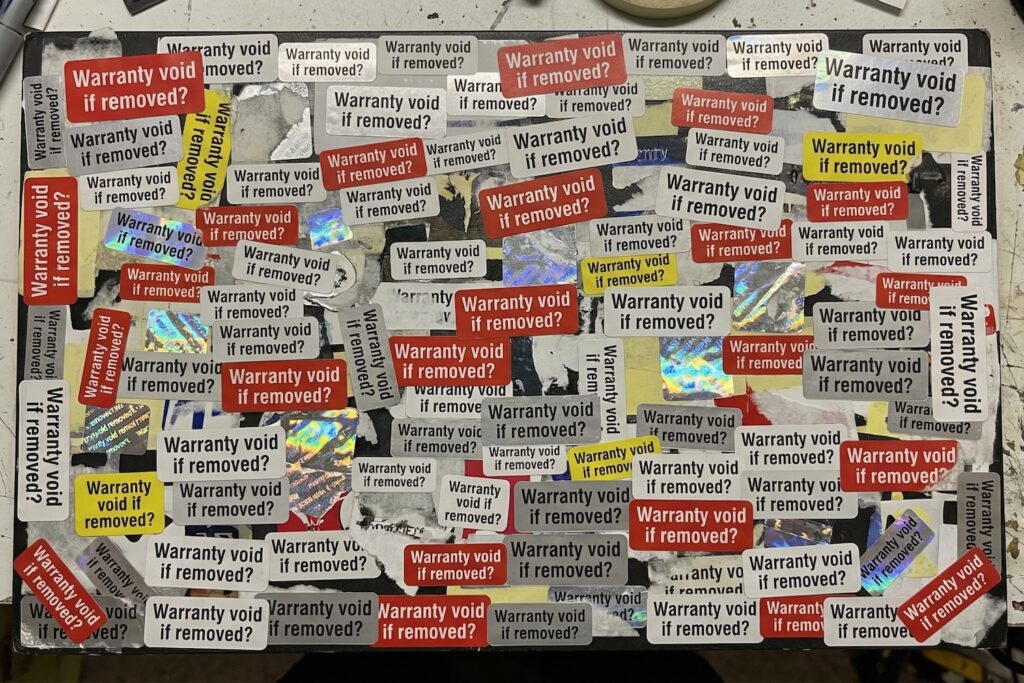
There’s a small sticker inside almost every electronic device you’ve ever owned. It’s usually placed over a screw or along a seam – somewhere you’d have to break it to open the case. The message is simple: Warranty Void If Removed.
It’s also illegal. It has been since Gerald Ford was president.
The Law Nobody Enforced
On January 4, 1975, President Ford signed the Magnuson-Moss Warranty Act into law. Sponsored by Senator Warren Magnuson of Washington and Representative John Moss of California, the Act went into effect six months later on July 4, 1975. Its purpose was straightforward: stop manufacturers from using warranties to deceive consumers.
Section 102(c) is the part that matters here. It prohibits any warrantor of a consumer product from conditioning warranty coverage on the consumer’s use of any article or service “identified by brand, trade, or corporate name” – unless that article or service is provided for free. In plain language: a company cannot void your warranty because you used third-party parts or had someone else do the repair.
The Federal Trade Commission’s own regulation, 16 CFR § 700.10, spells it out with unusual clarity. Provisions like “This warranty is void if service is performed by anyone other than an authorized dealer” and “all replacement parts must be genuine parts” are explicitly prohibited. The regulation calls these provisions illegal in two distinct ways – as unlawful tying arrangements under Section 102(c), and as independently deceptive practices under Section 110 of the Act.
The law applies to any consumer product costing more than five dollars. It has been continuously in effect for over fifty years. The enforcement record tells a different story.
Forty-Three Years of Silence
For decades after the Magnuson-Moss Act became law, the FTC did almost nothing to enforce the anti-tying provision against warranty-voiding stickers and language. Companies across every consumer electronics sector continued to print the stickers, place them over screws, and tell customers – explicitly or implicitly – that opening their own device would void the warranty.
The first meaningful enforcement action didn’t arrive until 2015, when the FTC charged BMW’s MINI Division with violating the Act. BMW had been telling MINI owners that their warranty would be void unless they used MINI parts and MINI dealers for all maintenance and repair work. The proposed consent order was announced in March 2015; the final order was approved that October, requiring BMW to notify affected owners of their right to use third-party parts and service. The order would remain in effect for 20 years. No fine was issued.
“It’s against the law for a dealer to refuse to honor a warranty just because someone else did maintenance or repairs on the car,” Jessica Rich, then-Director of the FTC’s Bureau of Consumer Protection, said at the time. She was describing a right that had existed for forty years.
Three more years passed before the FTC addressed the stickers themselves.
2018: The Warning Letters
On April 9, 2018 – forty-three years after the law took effect – the FTC sent warning letters to six companies. The agency initially declined to name them. A Freedom of Information Act request filed by Motherboard revealed the recipients: Hyundai, ASUS, HTC, Microsoft, Nintendo, and Sony.
The language the FTC flagged was remarkably blunt. From the released letters:
- “The use of [company] parts is required to keep your manufacturer’s warranties and any extended warranties intact.”
- “This warranty shall not apply if this product is used with products not sold or licensed by [company].”
- “This warranty does not apply if this product has had the warranty seal on the altered, defaced, or removed.”
Each company was given 30 days to correct potential violations. Thomas B. Pahl, Acting Director of the FTC’s Bureau of Consumer Protection, offered a statement that functioned more like a public reminder: “Provisions that tie warranty coverage to the use of particular products or services harm both consumers who pay more for them as well as the small businesses who offer competing products and services.”
By the end of 30 days, several companies had updated their language. Hyundai revised its warranty page to say the use of genuine parts was “strongly recommended” – rather than required. Others quietly removed the most egregious clauses.
No fines were issued.
The 90 Percent Problem
Six months after the FTC’s warning letters, the consumer advocacy group U.S. PIRG published a study that suggested the problem went far deeper than six companies.
PIRG researchers examined the warranty policies of 50 companies in the Association of Home Appliance Manufacturers (AHAM). When warranty language was unclear, they contacted the companies directly through customer service lines. The result: 45 out of 50 companies – 90 percent – told customers that independent repair would void their warranty.
“Warranties should honor our right to repair,” Nathan Proctor, Senior Director of U.S. PIRG’s Campaign for the Right to Repair, said at the time.
The study underscored an uncomfortable reality: the FTC’s 2018 letters had targeted six companies in a marketplace where nearly all of them were doing the same thing. And the enforcement mechanism – a warning letter with a 30-day deadline and no financial penalty – had little deterrent effect on the hundreds of companies that never received one.
The Enforcement Escalation
In June 2022, the FTC moved from warnings to orders. The agency took formal action against Harley-Davidson and Westinghouse (through its parent MWE Investments), as well as grill maker Weber-Stephen Products, for illegally restricting customers’ right to repair.
This time, the consequences had teeth. The FTC ordered each company to:
- Remove illegal warranty terms
- Add explicit language to their warranties stating: “Taking your product to be serviced by a repair shop that is not affiliated with or an authorized dealer of [Company] will not void this warranty. Also, using third-party parts will not void this warranty.”
- Notify existing customers that their warranties remained in effect regardless of who performed repairs
- Ensure dealers compete fairly with independent repair shops
Future violations would carry civil penalties of up to $46,517 per violation.
Then, in July 2024, the FTC sent a second wave of warning letters – this time to eight companies. Three of them – ASRock, Zotac, and Gigabyte – were flagged specifically for using “warranty void if removed” stickers on gaming PCs, graphics cards, and motherboards. Five others – aeris Health, Blueair, Medify Air, Oransi, and InMovement – were warned about warranty language conditioning coverage on the use of specific parts or services.
“These warning letters put companies on notice that restricting consumers’ right to repair violates the law,” said Samuel Levine, Director of the FTC’s Bureau of Consumer Protection.
Nearly fifty years after the law was enacted, the FTC was still sending companies the same message.
Why Companies Keep Doing It
The calculus is not complicated. Most consumers don’t know the Magnuson-Moss Act exists. They see the sticker, assume it’s enforceable, and either avoid self-repair entirely or return to the manufacturer for service – often at a significant markup.
As one Reddit commenter put it plainly: “Most companies will basically nicely say ‘take us to court’ because they know most consumers won’t try to legally fight a giant corporation over a voided warranty. It deters most users from repairing their devices and they can throw pocket change worth of legal fees at the few that actually try to fight it.”
The economics support this. According to a 2023 U.S. PIRG study, Americans spend an average of $1,767 per household per year on electronics and appliances. Repair could reduce that spending by 21.6 percent – saving an average family $382 per year. Across 129 million households, that amounts to $49.6 billion in annual consumer spending that repair restrictions help protect.
For manufacturers, steering consumers away from independent repair and toward authorized service networks – or toward buying a replacement – is not a bug in the warranty system. It’s the business model.
The Sticker Is Still There
Despite two rounds of FTC warning letters, three formal enforcement orders, a congressional report (the FTC’s 2021 “Nixing the Fix”), and a growing wave of state right-to-repair laws, the sticker persists.
As of 2023, iFixit – the largest independent repair guide platform – confirmed that the U.S. is the only country where “warranty void” stickers are explicitly illegal. But even here, iFixit noted, “companies continue to use warranty-voiding stickers” despite the FTC’s position.
The stickers show up covering screw holes on laptops, sealing seams on gaming consoles, lining the interiors of smart home devices. They don’t carry the force of law. They never did. But they carry the force of assumption – and for most consumers, that’s enough.
The Bigger Shift
The warranty sticker is a small piece of a larger fight. Between 2023 and 2025, at least eight states passed comprehensive right-to-repair laws covering consumer electronics: New York, California, Minnesota, Colorado, Oregon, Connecticut, Washington, and Texas – the last with unanimous bipartisan support in both chambers.
These laws go further than Magnuson-Moss. They require manufacturers to provide diagnostic tools, replacement parts, repair manuals, and software updates to consumers and independent repair shops. California’s law covers any device over $50, with penalties of up to $5,000 per day for third and subsequent violations. Oregon became the first state to prohibit “parts pairing” – the practice of using software to disable functionality when a non-OEM part is installed.
But as WIRED reported in December 2025, manufacturers are now engaging in what iFixit CEO Kyle Wiens calls “malicious compliance” – technically providing repair information while making it practically unusable. Manuals are technically “available” but nearly impossible to navigate. Parts are sold at prices that make repair irrational compared to replacement.
“We’re observing varying degrees of malicious compliance from different companies,” Wiens said.
The next fight is no longer about passing laws. It’s about making companies follow them.
What This Actually Tells Us
A sticker that says “Warranty Void If Removed” is, in the most literal sense, a lie printed on adhesive. It represents a legal claim that has been prohibited by federal law for more than fifty years. The FTC has said so publicly, repeatedly, across multiple administrations. Courts have upheld it. Congress reinforced it.
And the sticker is still there.
Not because it’s legal. Not because it’s ambiguous. But because it works. Because most people, when confronted with an authoritative-looking warning on a product they just paid hundreds of dollars for, will comply with the instruction rather than research the law behind it. That compliance gap – between what the rules actually say and what people believe they say – is worth billions of dollars a year to the companies that exploit it.
The Magnuson-Moss Warranty Act didn’t fail. It was simply never enforced with enough force to change behavior. And in the absence of enforcement, a sticker did what fifty years of federal law could not undo: it convinced millions of people to ask permission to fix what they already own.
Sources: FTC Press Release, April 2018 · FTC Press Release, July 2024 · FTC v. BMW/MINI, 2015 · FTC v. Harley-Davidson & Westinghouse, June 2022 · 16 CFR § 700.10 · Magnuson-Moss Warranty Act, 15 U.S.C. § 2301 et seq. · TechSpot / FOIA: Companies Named · Vice/Motherboard: US PIRG Study · U.S. PIRG: Repair Saves Families Big, 2023 · FTC: Nixing the Fix, 2021 · iFixit: Warranty Void Stickers Globally · WIRED: Right to Repair, Dec 2025 · Crowell & Moring: Right to Repair State Laws · Ars Technica, April 2018